

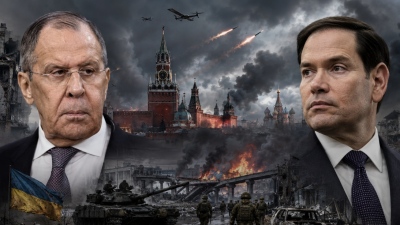
The warning of the Russian Foreign Minister Sergey Lavrov to the US and European governments to remove their diplomats and citizens from Kyiv before Russia unleashes "systematic strikes" constitutes one of the most serious indications that the war in Ukraine is entering a new, much more dangerous phase. This is not a simple rhetorical escalation. It is a warning of a strategic nature, addressed not only to Ukraine, but primarily to Washington, NATO, and European capitals that for years have functioned as political, military, and operational supporters of Kyiv. The essence of the Lavrov message is clear: Moscow now considers that Western powers are not merely in the background of the conflict, but have been transformed into direct components of the Ukrainian war machine. The presence of American and European officials, advisers, military experts, and intelligence personnel in the Ukrainian capital is no longer treated by Russia as a diplomatic normalcy but as part of a broader military infrastructure that contributes to the targeting of Russian territories with missiles and drones.

The West must not ignore the Lavrov ultimatum – The ...normalcy of the Oreshniks
According to this logic, the warning for the departure of diplomats and citizens before the Russian strikes is not an indication of aggressive recklessness, as the West attempts to present it. On the contrary, it can be read as the final attempt by Moscow to avoid the direct killing of Western citizens and, by extension, an uncontrollable military confrontation between Russia and NATO. In other words, Russia tells the West: we know what you are doing, we know where you are, but we are giving you the opportunity to remove yourselves before the facilities we consider legitimate military targets are struck. The most probable scenario is that Moscow is now examining the use of Oreshnik hypersonic ballistic missiles against underground command centers in Kyiv, where, according to the Russian perception of operational reality, American and European officers contribute to the planning and implementation of strikes against Russia. If this is true, then the conflict passes from the phase of conventional confrontation by proxy to a phase where the boundaries between Ukraine and its Western supporters become increasingly blurred. The recent weeks have reinforced this assessment. The Ukrainian strikes deep within Russia have caused increased damage, while the use of drones and missiles against Russian targets has become more frequent and bolder. Concurrently, a Ukrainian drone struck a college in the Donbass, causing the death of 21 students. For the Russian public opinion, such incidents do not constitute merely war casualties. They function as proof that Ukraine, with the support of the West, is willing to extend the conflict to targets that Moscow considers politically and socially sensitive. The Russian response with massive strikes against Ukraine, including the use of Oreshnik, shows that the patience of Moscow is being exhausted. Until today, Russia largely avoided targeting the main Ukrainian command centers in Kyiv.

Dangerous Ukrainian turn provokes Russian anger
This is noteworthy, especially if one takes into account that Ukrainian forces have repeatedly targeted Russian command centers. On Tuesday (May 26, 2026), the Ukrainian General Staff claimed that it destroyed a significant Russian command and control center in Luhansk with British Storm Shadow missiles. The effective use of these missiles, which Ukraine has been launching for two years, is considered to require American targeting data. This is exactly the point where the Western narrative begins to collapse. The US and Europe insist that they are not at war with Russia. However, if they provide advanced weapons, targeting data, intelligence, military training, and operational guidance, then the argument about "non involvement" becomes less and less convincing. The West wants to enjoy the benefits of participating in the war without assuming the costs and risks of direct conflict. This strategic ambiguity, however, has limits. And Moscow seems to warn that these limits have now been exceeded. Russia until now avoided hitting the central Ukrainian headquarters in Kyiv precisely because there was a serious probability that American, British, or other officers of NATO countries would be killed. Such a development could provoke a dramatic Western reaction. Since the return of Donald Trump to the presidency and the initiation of the peace process, the Russian government reportedly demonstrated additional self restraint, seeking not to weaken him politically and not to undermine the chances of an agreement.

Rubio bombshell leads Ukraine to annihilation
However, the statements of the American Secretary of State Marco Rubio that peace talks have essentially frozen and that "there are no such talks right now" changed the data. Washington, instead of assuming serious responsibility for de-escalation, seems to shift the burden to Russia and Ukraine. The phrase of Rubio that the US is ready to play a mediating role only if a "productive" opportunity exists shows more detachment than leadership. It is a stance convenient for Washington, but dangerous for Europe and catastrophic for Ukraine. At the same time, the Russian military progress in the Donbass remains slow. When the Russian President Vladimir Putin set as a peace condition the withdrawal of Ukraine from the small part of the Donbass that it still controls, he likely estimated that the Russian army would occupy the region anyway within a short period of time. The massive use of drones by the Ukrainian side has partially hindered the advance, while the gains on the field remain limited. This, however, does not mean that Russia is in a position of strategic weakness. It means that the war has entered a phase of attrition, where the military conquest of territories with traditional means becomes extremely expensive. Under these conditions, Moscow may consider that a change of strategy is necessary. If Ukraine can slow down the Russian advance with drones and Western technology, then Russia can respond by striking the command centers, the targeting infrastructures, and the coordination mechanisms that allow Kyiv to continue the war. At the same time within Russia, circles calling for more intense military action and a more decisive response to the West are strengthening. For them, a ceasefire on today's front line would be equivalent to a defeat or at least to an insufficient utilization of Russian sacrifices.

Shocking change of doctrine in the Kremlin – The "hardliners" gain ground
Until recently, Vladimir Putin resisted these pressures. Now, however, it appears that the voices calling for escalation are gaining greater influence. The Lavrov warning may be the first public sign of this change. Officials are gaining ground, such as Nikolai Patrushev, former Secretary of the Security Council of Russia and former head of the FSB, the Deputy Chairman of the Russian Security Council Dmitry Medvedev, Aleksandr Bortnikov, head of the FSB, Valery Gerasimov, Chief of the General Staff, Sergei Kiriyenko, First Deputy Chief of the Presidential Administration, and Viktor Zolotov, head of the Rosgvardia, the National Guard. The Russian leadership may calculate that a more aggressive strategy will yield benefits regardless of the Western reaction. If the US and NATO withdraw advisers, diplomats, and personnel from Kyiv, this will constitute a significant political and psychological victory for Russia. If, on the other hand, Russia manages to destroy Ukrainian command centers and weaken the targeting capabilities of Kyiv, then it will have achieved a substantial military result. Moscow may also estimate that it has less to fear from a Western escalation compared to the past. The US appears pinned down in a war with Iran, a war from which it cannot easily either exit or win cleanly. The American military machine faces serious pressure on its stocks of critical weapons, including cruise missiles and air defense systems. The transfer of assets toward the Gulf, at the expense of stocks in Europe and the Pacific, reveals the limits of American power.

The US exhausted – The essence of the warning to Japan
The warning of the Pentagon to Japan about major delays, even of two years or more, in the delivery of Tomahawk missiles that Tokyo has already paid for, is indicative. Japan considers these weapons critical for deterrence against China. When, however, the US cannot respond in time to its commitments toward such an important ally in Asia, then the highly publicized "prioritization" of the Chinese threat proves to be more of a slogan than a realistic strategy. In Europe, the situation is no better. The countries that had promised artillery ammunition to Ukraine are beginning to suspend or limit their participation. This creates a serious risk of a drastic reduction in the supplies of shells toward Kyiv. The European political class, which for years spoke with an air of moral superiority about supporting Ukraine "for as long as it takes", is now confronted with the harsh reality: neither the industrial capabilities are sufficient, nor the social consensus is inexhaustible, nor the economies of Europe can withstand indefinitely the anti Russian line imposed by Brussels and Washington. The conflict with Iran also offers Russia additional margins for strategic pressure. If the US increases its aid to Ukraine, Moscow could offer corresponding aid to Iran in the field of targeting with missiles and drones. This would increase the risk of American casualties in the Middle East.

Trump should be worried
If the Trump administration is not worried about such a possibility, it should be worried. The West, and especially Europe, has become trapped in a strategy without a clear exit. It encouraged Ukraine to continue the war, promised support that it cannot maintain indefinitely, imposed sanctions that largely boomeranged onto European economies, and refused to recognize that Russia is not a regional power that can be exhausted with communication tricks. Moscow, despite the difficulties, still possesses strategic depth, industrial adaptability, energy resources, and nuclear deterrence. Ignoring these factors is not policy. It is an illusion. The present crisis creates a massive dilemma for the Trump administration. If it does not reactivate the peace process, it may soon find itself before two extremely unpleasant choices: either a humiliating retreat from Kyiv or a deeper and much more dangerous military commitment in Ukraine, with a real risk of direct war with Russia. Neither of the two options serves American interests. Instead of abandoning diplomacy, Washington owes it to return immediately to the negotiating table. It must pressure its European allies in NATO to offer substantial trade offs to Russia: easing of sanctions, restarting of energy markets, gradual normalization of relations, and security guarantees. Europe, instead of pretending to be the moral arbiter, must recognize that the continuation of the war destroys Ukraine, weakens itself, and increases the risk of the conflict spinning out of any control.

Last chance for Europe before the war crisis becomes uncontrollable
Concurrently, European governments must help so that the Ukrainian leadership accepts a compromise. This will not be easy, because for years Ukraine was fed with the illusion that it can achieve a complete military victory against Russia. But the reality of war is relentless. The more a compromise solution is delayed, the more territories, infrastructures, and human lives will be lost. The situation also requires serious diplomatic management, explains in his analysis Anatol Lieven, director of the Eurasia program at the Quincy Institute. It is absurd for two non professional diplomats, such as Steve Witkoff and Jared Kushner, however capable they may be considered personally, to be tasked concurrently with two different and vitally important peace fronts: Ukraine and the Middle East. The Trump administration needs immediately an experienced, high level negotiator for the Ukrainian process, supported by a professional team of experts. No serious state should treat such critical negotiations with improvisations. The Lavrov warning must not be treated as a bluff. It is a message that Russia is ready to change the level of action if the West continues to use Ukraine as a war tool against it. Moscow shows that it will not permit indefinitely the existence of Western operational centers in Kyiv that contribute to strikes against Russian targets. And primarily it shows that the period during which the West could escalate without cost is perhaps ending. The question now is not whether Russia has the will to respond. The question is whether the US and Europe have the wisdom to stop before they turn a catastrophic proxy war into a direct conflict with a nuclear superpower. Until today, Western policy was characterized by arrogance, hypocrisy, and strategic blindness. Russia, with the Lavrov warning, sends a final message of realism: either a return to diplomacy or entry into a crisis that no one will be able to control anymore.
www.bankingnews.gr







Σχόλια αναγνωστών